

Cape Town, 13 August 2026
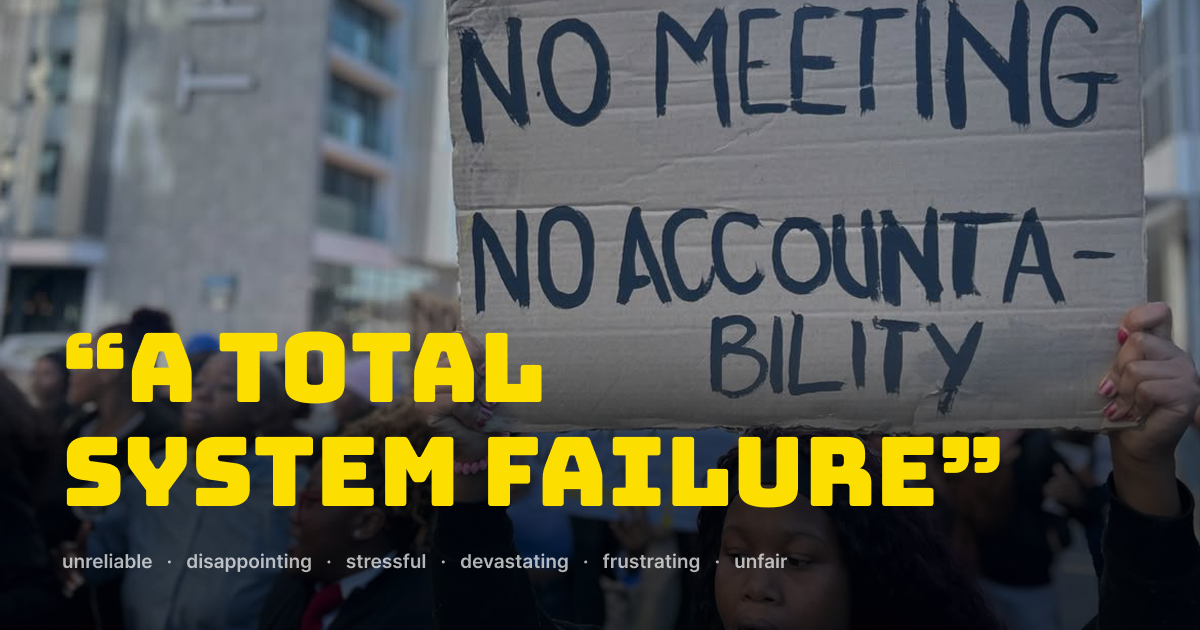
Equal Education, Youth Capital, and student leaders from different universities and TVET colleges across the country demand greater accountability and improved performance from NSFAS, following a tense day of student mobilisation that ultimately forced the Scheme to engage with the young people it had committed to meeting.
What happened on 11 August
On the 11th of August 2026, Equal Education, together with Youth Capital, scheduled a hybrid roundtable discussion with the National Student Financial Aid Scheme (NSFAS) to address ongoing issues that adversely affect students who rely on this fund day to day. The engagement was planned well in advance. Students mobilised and gathered in different locations to consult and table their grievances directly with NSFAS.
Students had travelled, gathered in Khayelitsha, while others waited and made themselves available online in anticipation of the engagement. Some students even travelled from outside the province specifically to participate. At the eleventh hour, however, NSFAS indicated that its senior leadership would no longer attend the engagement.
Equal Education, Youth Capital and students refused to accept that students who had organised, travelled and waited for NSFAS should once again be left without answers. Representatives from Equal Education and Youth Capital headed to the NSFAS offices in Cape Town CBD. They staged a peaceful sit-in, insisting that NSFAS leadership account directly to the students. Students who had gathered in Khayelitsha subsequently made their way to the NSFAS offices. For approximately 4 hours, students, Youth Capital and Equal Education remained at the NSFAS offices demanding an audience with senior leadership. NSFAS CFO, Wassim Carrim, eventually arrived and met with representatives of Equal Education and Youth Capital at the NSFAS offices.
However, the demand was clear: an engagement behind closed doors with civil society organisations could not substitute for accountability to the students themselves. The students had been invited to engage NSFAS directly; they showed up and therefore deserved to be addressed directly.
After further engagements, NSFAS officials eventually addressed students. By then, frustration among students had understandably intensified. Students had spent hours waiting for an institution that had initially committed to meeting them, only to withdraw at the last minute and then refuse to meet them when they arrived at its offices. As tensions rose, law enforcement officials were called to the NSFAS offices.
The presence of law enforcement in response to young people demanding answers about their education was deeply concerning. Students should not have to escalate their voices, occupy institutional spaces, or face the intimidation of law enforcement simply to secure an audience with a public institution whose mandate is to serve them. This is a phenomenon, the ongoing militarisation of campuses, that Equal Education and Youth Capital note with deep concern has become more prevalent at Higher Education Institutions (HEIs) over recent years.
The events of the day also demonstrated the power of organised young people refusing to be dismissed. Students showed up and demanded answers. And ultimately, NSFAS had to engage.
The NSFAS system failures students face every year
This inability or unwillingness of NSFAS senior management to meet with students where they are located and respond to their issues reflects a much deeper, ongoing problem: students have repeatedly struggled to be heard by an institution whose decisions directly shape whether they can access and remain in higher education.
Each academic year, without fail, students are forced to protest for equal access to quality higher education because of a system that does not work for them, according to their needs and priorities, in their contexts. When students finally get access, they are still plagued by the ongoing operational inefficiencies of the entity, including delays with payments of student allowances and accredited accommodation and other service providers. NSFAS is the closest thing this country has to a guarantee that apartheid’s economics won’t decide a young person’s future. Existing student allowance caps do not cover the needs of students’ growing cost of living. The cost of food and the cost of accommodation are rising, and students are expected to fill that gap. These are not minor administrative issues; they directly affect whether a young person can learn, eat, have somewhere to sleep, and the stability required for learning.
The NSFAS system is currently not conducive to good learning and education in this country. When we asked our tertiary society members (TSOC) and post-school youth members (PSY) how they would describe NSFAS, they used words such as: ‘unreliable’, ‘disappointing’, ‘stressful’, ‘devastating’, ‘frustrating’, ‘unfair’ and ‘a total system failure.’ These are the words from young people funded via the Scheme. These are the same students that the NSFAS office has decided not to hold itself accountable to and that they continuously struggle to contact and have their issues resolved. These are the students who continue to suffer under the mediocre services that are rendered by NSFAS.
The abject failure of NSFAS cannot be understated. The inability to meet students where they’re at will forever be documented in history. Fifty years after young people protested on the streets of South Africa, young people today still find themselves having to protest against a democratically elected government for the opportunity to access education again. NSFAS, in its current form, is failing to create the conditions students need to study and succeed. NSFAS’ failure to attend this engagement therefore mirrors the government’s overall failure to support student access to higher education. We have had Student Representative Council (SRC) members go to the Portfolio Committee of Higher Education and Training to speak on the issues of accommodation costs, the high cost of food and transport, only to be met with nothing but contempt and confusion.
When the scheme fails, the consequences are dire and are much greater than an unpaid allowance or an unanswered query. It places students’ education and futures at risk. How are young people meant to succeed and change the prospects of the future of this country if they are not adequately funded and resourced? Public money must be spent for the good of the public. That principle should be non-negotiable. This is happening at a time when young people are already facing high levels of unemployment, which wrecks their prospects of entering the economy and changing their futures for the good of this country.
What must happen on 25 August?
Youth Capital’s work is rooted in ensuring that the lived realities of young people are carried from communities and campuses into the rooms where policy, budgets and institutional decisions are made. Equal Education’s organising alongside students and young people on Tuesday demonstrated why both forms of advocacy matter: young people must have the power to organise and demand accountability, while their experiences must also shape the decisions taken by policymakers and institutions. Two forms of advocacy met. Students mobilised on the ground. Civil society stood alongside them. NSFAS was compelled to respond.
The work, however, is not finished. Following Tuesday’s engagement, NSFAS has committed to a further engagement with students and civil society on 25 August 2026. We expect that commitment to be honoured. On 25 August, students must receive more than explanations. They deserve clear answers to the issues they have raised, commitments from NSFAS leadership, and concrete actions with timelines for addressing the systemic failures that continue to undermine their ability to study and succeed. Public institutions cannot demand resilience from young people while failing to provide the systems that enable their success.
Students showed up on the 11th of August; they organised, they waited and demanded to be heard. NSFAS must show up on the 25th of August, ready not only to listen, but to account and act.
[END]
Issued jointly by Equal Education and Youth Capital
For media enquiries, please contact the following:
Equal Education: Sesethu August
Email: sesethu@equaleducation.org.za
Phone: 063 221 7983
Youth Capital: Sibabalwe Nobandla
Email: siba@youthcapital.co.za
Phone: 079 654 5387