

FOR IMMEDIATE RELEASE
Cape Town, 13 August 2026
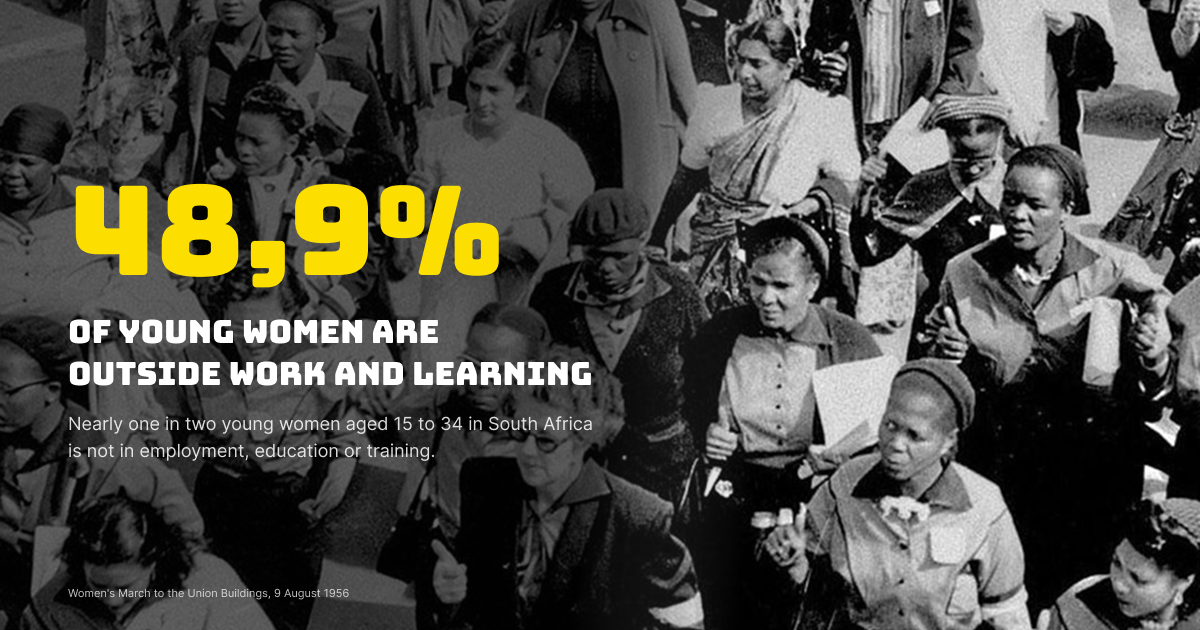
This Women’s Month, the language of economic empowerment is colliding with a brutal reality. The NEET rate for young women aged 15 to 34 in South Africa is 48,9%. Nearly one in two is not in employment, education or training.
The Quarterly Labour Force Survey (QLFS) for Q2: 2026 shows that the NEET rate for young women aged 15 to 34 stands at 48,9%, compared to 41,9% for young men. The gap between them is seven percentage points. And while the rate for young women declined marginally from the previous quarter, it remains 1,6 percentage points higher than it was a year ago. Behind that number is a daily reality: no income of her own, no first work experience to reference, no route back into learning, and unpaid care work filling the gap instead. This is the backdrop against which South Africa is talking about women’s economic empowerment this August.
For Youth Capital, that contradiction matters. “We cannot spend August telling young women to be resilient, entrepreneurial and economically empowered while nearly half of them are outside both work and learning. Economic empowerment is not a motivational message. It is about whether we have built and funded enough routes for young women to earn, learn, gain experience and participate in the economy,” said Buhlebethu Magwaza, Project Lead at Youth Capital.
What the QLFS Q2:2026 numbers show
The broader youth labour market reinforces the scale of that exclusion. Unemployment among young people aged 15 to 24 has risen to 62,8%, while the rate for those aged 25 to 34 is 41,8%. Almost five million young people across these two age groups are unemployed. But the QLFS also gives us reason to ask a more specific question this Women’s Month: what are we doing differently for the young women carrying an even heavier share of this crisis?
Why the NEET rate for young women is a public employment question
Youth unemployment and women’s economic exclusion are too often discussed as separate policy problems. For millions of young women, they are the same problem. And South Africa already has an intervention that shows what deliberate inclusion can look like. Since 2020, the Presidential Employment Stimulus has created more than 2,5 million work and livelihood opportunities. 82% of those opportunities have reached young people, and 66% have gone to women of all ages. Public Employment Programmes are therefore an instrument for women’s economic participation as much as they are a response to unemployment. They put income directly into people’s hands. They create first-work experiences and references. They build skills, networks, and confidence. And through programmes in schools, early childhood development, food security, community services and other areas, they turn work that communities need into paid opportunities.
“The data is telling us who is being left out. Public employment is showing us one way to bring them in. If two-thirds of these opportunities are already reaching women, then protecting and expanding public employment should be understood as part of our women’s economic empowerment agenda,” Magwaza said.
Yet these programmes continue to operate without predictable, multi-year funding that would allow them to meet the scale of the need.
What Youth Capital is calling for
Youth Capital is calling for Public Employment Programmes to be institutionalised as a permanent pillar of South Africa’s employment and social protection architecture, supported by ring-fenced, multi-year funding for at least one million quality opportunities every year for young people.
Women’s Month cannot only celebrate what women contribute to South Africa; it must confront how many are still excluded from its economy.
By next August, the measure of progress should not be how many times we spoke about empowering young women. It should be whether fewer of them are sitting outside employment, education and training; whether more have an income, experience and somewhere to contribute; and whether the budgets designed in their name have opened more doors.
Economic empowerment cannot just be commemorative; it has to be funded.
Add your name to the call for Public Employment Programmes at bit.ly/peps4youthmailchimp. Youth Capital hosts a Women’s Month webinar on 25 August unpacking what economic empowerment requires beyond August.
Read Youth Capital’s response to the previous quarter: South Africa’s labour market is not stalling. It is being defunded.
ENDS
Issued by Youth Capital
For media inquiries, please contact:
Sibabalwe Nobandla
Youth Capital Multimedia Strategist
Phone: +27 79 654 5387
Email: siba@youthcapital.co.za