

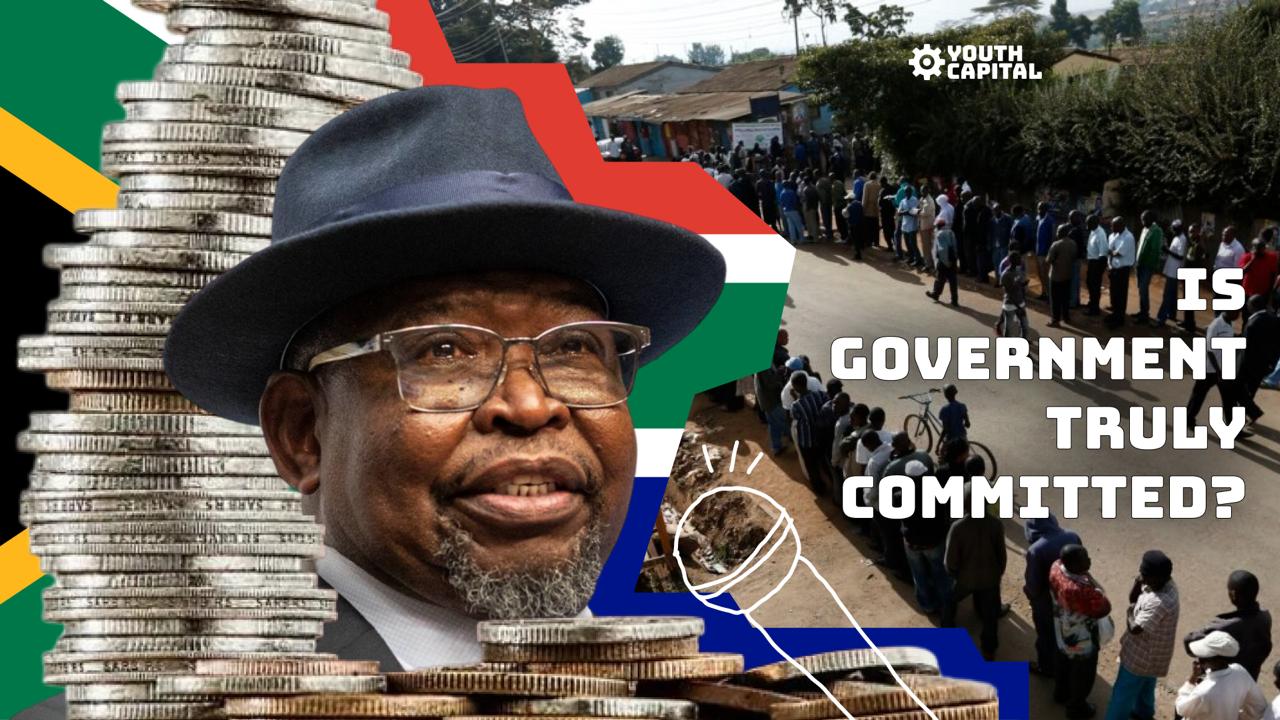
With nearly two-thirds of South Africa’s population being under 35 years old, the youth unemployment crisis in the 2026 National Budget felt like a footnote rather than a fiscal priority.
In the budget speech delivered by Finance Minister Enoch Godongwana, the minister focused heavily on stimulating economic growth, stabilising debt, and protecting the macroeconomy. However, the same cannot be said about the message to young people. There was no substantive articulation of how these fiscal choices would reduce youth unemployment; no clear allocations tied to job creation and no measurable pathway from economic stabilisation to employment outcomes for young people. If anything, this felt like a continuation of President Cyril Ramaphosa’s State of the Nation Address, where the youth unemployment crisis was acknowledged, but key interventions such as the public employment programmes came with no clear commitment to expansion or confirmed financial backing to scale them.
Public employment programmes are repeatedly presented as proof of impact, but the absence of measurable expansion and long-term funding undermines their potential. What remains is recognition without scale.
Youth Capital Project Lead, Buhlebethu Magwaza said, “While stabilising the economy is important, it is only meaningful if it creates jobs for the millions of unemployed young South Africans who need to be built into infrastructure plans. Stabilising the economy does not automatically create youth employment opportunities. Investment does not automatically reach young people, and opportunity does not trickle down on its own. If young people are not deliberately built into infrastructure plans, industrial spending, and fiscal design, they remain peripheral to the recovery. Young people do not live inside fiscal anchors. They are navigating hunger, mental strain, stalled ambitions, and the daily uncertainty of survival without work.”
The latest Quarterly Labour Force Survey for Q4 2025 shows that more than 4 in 10 young people aged 15 – 34 are unemployed. The expanded definition, which includes discouraged work-seekers, pushes this even higher. Nearly 10 million young people remain outside of employment, education, or training. These figures reflect not just economic stagnation, but a generation navigating prolonged exclusion.
In the speech, there was no funded, time-bound youth employment target. The Budget contained detailed multi-year projections for debt, deficits and primary surpluses but not a single measurable commitment to reducing youth unemployment. No five-year target. No annual reporting benchmark and no named political owner. Youth unemployment was referenced as part of the broader constitutional mission but has no confirmed and sustained financial backing. Addressing debt had a target, the deficit had a target, and the primary surplus had a target, but addressing youth unemployment did not.
The Minister described this Budget as an “important turning point” in the management of public finances. And indeed, debt is stabilising, the deficit might be narrowing, and investor confidence is improving. But for millions of unemployed young people, this turning point does not yet translate into a funded pathway to work. Fiscal consolidation may mark restored credibility for markets, but it does not yet mark a turning point for youth exclusion.
With infrastructure spending similarly lacking deliberate youth inclusion mechanisms, Magwaza added, “The R1 trillion projected to be spent on infrastructure over the medium term could represent a generational opportunity. But without enforceable youth hiring conditions, apprenticeship-to-project ratios or youth enterprise procurement requirements, it risks reproducing growth without youth inclusion.”
The admission that the SETA and skills levy system “has not yielded the outcomes expected” is significant. However, without a cost reform package, legislative amendments or a time-bound restructuring plan, the statement remains diagnostic rather than corrective, signaling delay and not transformation.
“Youth unemployment has been acknowledged as a crisis for years. If that acknowledgement is not matched by measurable commitments, enforceable conditions and scaled allocations, it begins to look less like a crisis response and more like managed tolerance. In this Budget, youth unemployment was not operationalised in fiscal terms. What we are seeing is fiscal consolidation without structural reorganisation around the country’s largest economic exclusion,” said Magwaza.
For a country whose majority is young, the exclusion of youth employment from the financial centre of the Budget is not just an oversight; it is a decision that has and will continue to shape inequality, economic stagnation and social instability.
Youth Capital, once again, calls on the Minister of Finance and National Treasury to publish a Youth Employment Impact Statement and, additionally, based on that assessment, table a funded, time-bound National Youth Employment Plan ahead of the 2026 Medium-Term Budget Policy Statement (MTBPS). Youth Capital stands ready to support this process by systematically surfacing the lived experiences of young people across the country, translating those insights into policy-relevant evidence, and contributing to transparent monitoring of youth employment commitments. Fiscal design cannot happen in isolation from the realities it affects. Young people must not only be beneficiaries of policy; they must be visible within its design and evaluation.
Ends
For media inquiries, please contact:
Murphy Nganga
Youth Capital Communications Lead
Phone: 073-987-4061
Email: murphy@youthcapital.co.za